Last month I started a spiritually themed book of exercises that offered, in thirty days of committed practice, to Sherpa me through further self-examination. Each chapter offers thoughtful discussion and prompts, based on the author’s own trek in this territory of searching.
Week one was fine, but on the evening of Day Seven (it would be a seven, of course) I realized I’d not done the exercises. I would catch up on Day Eight, I promised myself. Day Nine rolled around and I did three days at one whack, but I was dismayed to find the material was not landing for me, and disappointed in myself.
Some real-life entries from my journal: “Nope,” and “What?” and “This feels like old ground.” That was as far as I got, with some chapters. This caused me to feel failure, and as if this book that has done good for so many people, been workshopped all over the country and widely praised, was meant for searchers with more commitment, openness, and worth than me.
But in truth, this is simply not my book. It’s a great book. It’s just not my book. The enjoyment and hopeful feeling I got from researching and then choosing it, finding a stray notebook to use as a journal dedicated only to these exercises, and the carefully dated headings I put on each entry to show that I had made the effort still could not make the book a match to where I am now.
I’ve read recently that if you are “neuro-spicey,” you get a dopamine hit out of setting up systems and designing routines for yourself. You don’t actually do them, probably; it’s the creation of them, and the promise of efficiency and productivity they promise, that soothe the jumpy, restless brain and assure it that it, too, can find a way to fit in.
“Neuro-spicey” is a term I love, because I think “neurodivergent” people are the norm, not the exception. But particularly when the industrial age became the cultural framework of the modern world, the emphasis became shoehorning people into managed categories so they’d be easy to slot into jobs with repetitive work. Assembly lines, manufacturing plants, process jobs.
It became critical to get in line with what was expected of us, so that we could follow the pattern and realize the ambitions of a few power players, while being sold the idea of what makes a decent and respectable life. Anybody outside of that, anybody different from the majority, was labelled unfit for purpose, as the Brits would say. If you were not able to blend in, or contain yourself, you stuck out and then you were undesirable, outside the norm, labelled.
I think that one-size-fits-most idea is getting blown up now (deservedly so,) and the baseline of what makes a proper, socialized human is currently shifting. But it still shows up covertly, even in efforts we look to for support in finding our own paths and understanding ourselves.
In the genre of self-help or spiritual seeking, we have to stay aware of the cultural framing that makes up the foundation of the world in which we live, even if the foundation is tilting now. We have to learn to embrace what is neuro-spicey about us, using that as a broad and friendly term to suggest an alternative to the “normal” and “average” working consciousness that is not as common, or widespread, as we have been taught.
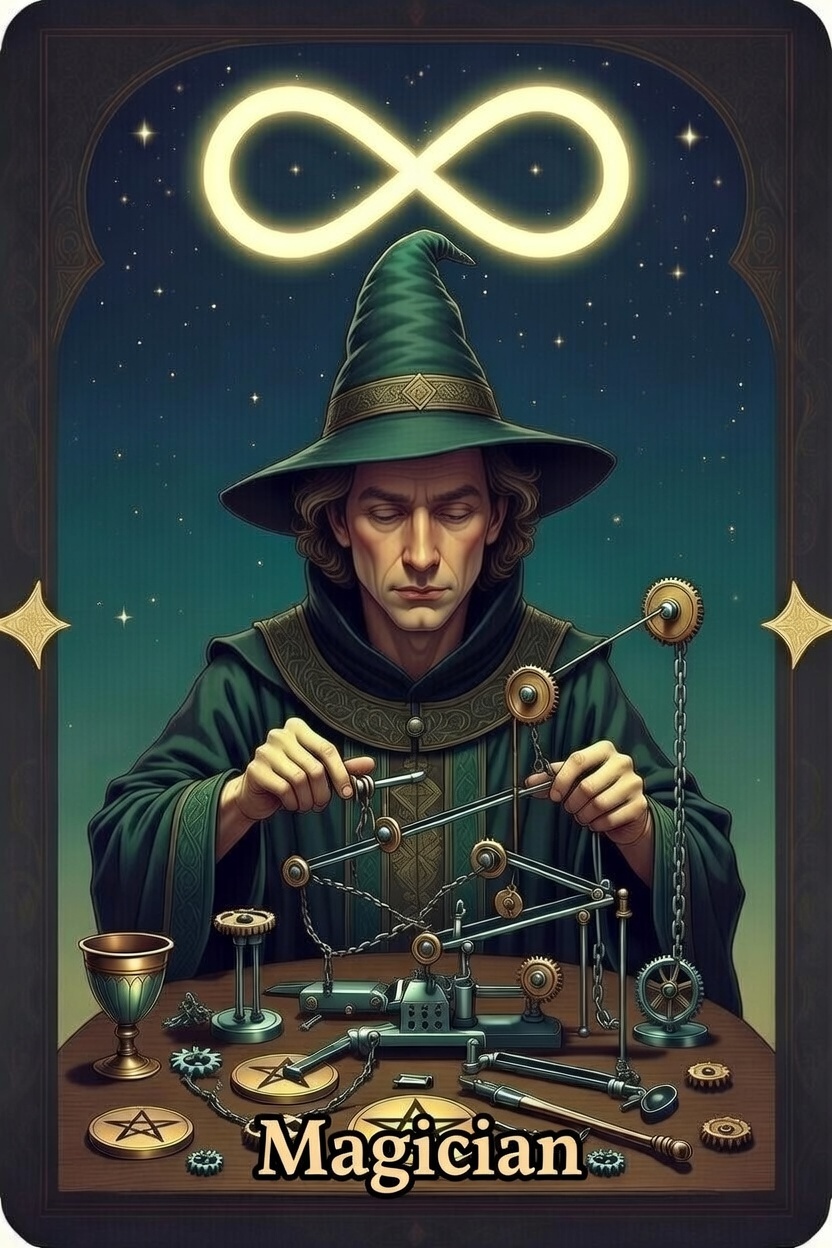
The most neuro-spicey card in the Tarot is the Magician. Not the Fool, because the Fool lacks the deliberation of the Magician. The Magician is in no way interested solely in end results; he is interested in how things develop into being. His brain is a fantastic Rube Goldberg machine. His ideas are constantly linking up and weaving in, around, and through each other even when made up of seemingly disparate parts.
He has no interest whatsoever in how you do it, how you’d like him to do it, how the teacher or the boss says he should do it. The Magician is not interested in fitting in, or if you like him. He is fully attuned to the forward motion of his consciousness, as it teaches him how he might create something out of nothing.
A quick, one sentence interpretation of the Magician in a Tarot spread or a daily draw would be the counsel to do what you need to do, your way. This is not a card about fitting in, although young Magicians may sometimes use their abilities to do that, in hopes it will make them feel (momentarily) less anxious about other people. Like the dopamine hit from creating a system to funnel his rowdy consciousness, attempts to buffer the Magician’s neuro-spiciness into something society calls “normal” are only briefly rewarding.
Society would be so much healthier if we stopped trying to make our Magicians be like everybody else. It’s something we can keep in mind, to stop doing it to ourselves, too.