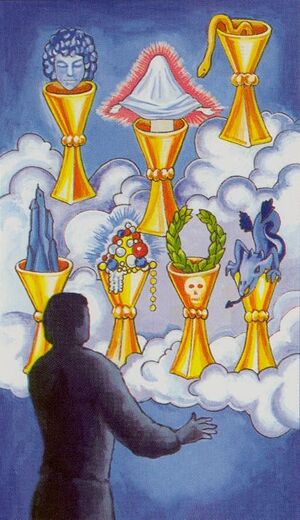
7 of Cups
The world is in a big, fat uproar and over here I am reading Little House books to my mother, who has dementia and does not remember who anybody is, and only vaguely recalls parts of herself. Her fraying, working consciousness wafts things across a mental screen, or lets them come to the surface in some rhythm nobody understands or can predict. Always a talker, she still has the impulse to comment or respond but specific words are mostly absent, and often made up entirely.
Conversation is impossible, and if I wanted to see a glimmer of recognition or comprehension while updating her on the family, I would have to demand it by correcting her, rephrasing her garbled sentences, telling her that she doesn’t remember, and reminding her that she has lost herself.
The best advice I have found on dealing with a dementia patient is to enter their world and not try to pull them out of it, and into our reality. This has guided how I try to help my mother. Every visit that I read Little House to her is the first time. She has no memory of what happened in previous chapters, but enjoys the movement of the language and the descriptions of rural life.
When my mother is listening to a story, there is no need to address, alter, or amend her current state.
This month I’ve thought a lot about personal reality, and how much people experiencing the same basic circumstances can vary in their perception of them. Some days are more upsetting than others, when a big segment of the population can seem to me utterly unreasonable and lost, and the validations people require of us feel outrageous.
We are not going to escape upheaval, not on a national or global stage, or in our private lives. But we can respect another person’s reality even if it is not ours.
I could not live in my mother’s world, but I am not going to treat it like something to be torn down and conquered. When I am not with her, it is unnecessary for me to keep a foot in her experience. I’m a visitor, not a resident, and that also feels like something helpful to remember when I note behavior, from individuals or groups, that I find upsetting or incomprehensible.
I am a guest in my mother’s present situation. I do not have to participate, nor does it affect me, not really, unless I open the door and bid what upsets me about it into my own house.
There is an alarming number of bear stories in Little House in the Big Woods, which I’d forgotten, and some mentions of butchering stock. The forest animals roam the woods still unafraid of pioneers, and there is a hair-raising yellow jacket incident. I edit these scenes out of the stories I read to my mother, even though they are authentic and true.
This reminds me to weave in and out of other people’s stories, too; the ones that aren’t written in books but burst across our screens and feeds. Reality is a curated thing, I realize with more emphasis than before. We make things worse when we try to force our version of it onto someone else.
In relating a Tarot card to this, the easy choice is the Hanged Man, as he steps back to have a big-picture perspective. But for a more practical strategy, it was a toss-up between 7 of Cups and 7 of Wands. As I read Tarot, Cups are feelings and the inner world while Wands are the desires and ambitions that drive us. First we want something, then it engages us emotionally and lets us invest in it and take it forward, if it is compelling enough.
And seven? Divine seven is the crazy number, the signifier of a higher force; not a gentle, New Testament version of it, but the Old Testament, sandy desert Gods who set things on fire and turn people into pillars of salt. Seven is the God you don’t look at directly, the one you take your shoes off for. Anything can happen. You are reminded that you are in charge of diddly squat: not floods, not bears, not dementia.
So we have number seven’s holy fire with unpredictable consequences (just to make the point,) and that is combined with emotions or desires. Feelings and hungers can be equally uncontrollable, but in assigning a Tarot card to the general frustration and actions at work in the world currently, I am going to go with 7 of Cups.
We can live without getting what we desire. But we can’t live without feelings.
That makes it all the more important to make sure that what we are feeling belongs to us, and hasn’t been invited over from someone else’s version of reality.