Friends, I know you’ve likely had no reason to think about the Robinsonites, but I’ve returned to New Switzerland about a thousand times in my mind since I posted about it earlier this month.
I am wondering what kind of prayers, what kind of creed, what kind of framework would support the Church of the Swiss Family Robinson. Before I can express what I imagine the architecture of Robinsonism to be, I have to find the arch from which to hang this flag, and that starts with identifying its deity.
The Robinsons would hate that. They, and their author/creator, were Protestant Christians so this was not a question for them, nor will it be for any person of a defined faith. My developing Robinsonite order is more a philosophy and lifestyle strategy than a religion. But even a philosophy must be anchored to something solid, or it is just a balloon with no string, bouncing against the ceiling as drafts waft it around.
Religious people have supportive practices and traditions suited to every circumstance; but for the Swiss Family Robinson, all of the daily devotions had to be stripped down to the bare bones of what would sustain them in extreme circumstances. Surviving on the island after a shipwreck sandblasted the gilding off, to show the metal underneath.

Nobody worries about forgetting it was Lent or missing church on Sunday when wringing out salty, waterlogged clothes and wondering what carnivorous predator in the jungle’s lush undergrowth might be sizing them up.
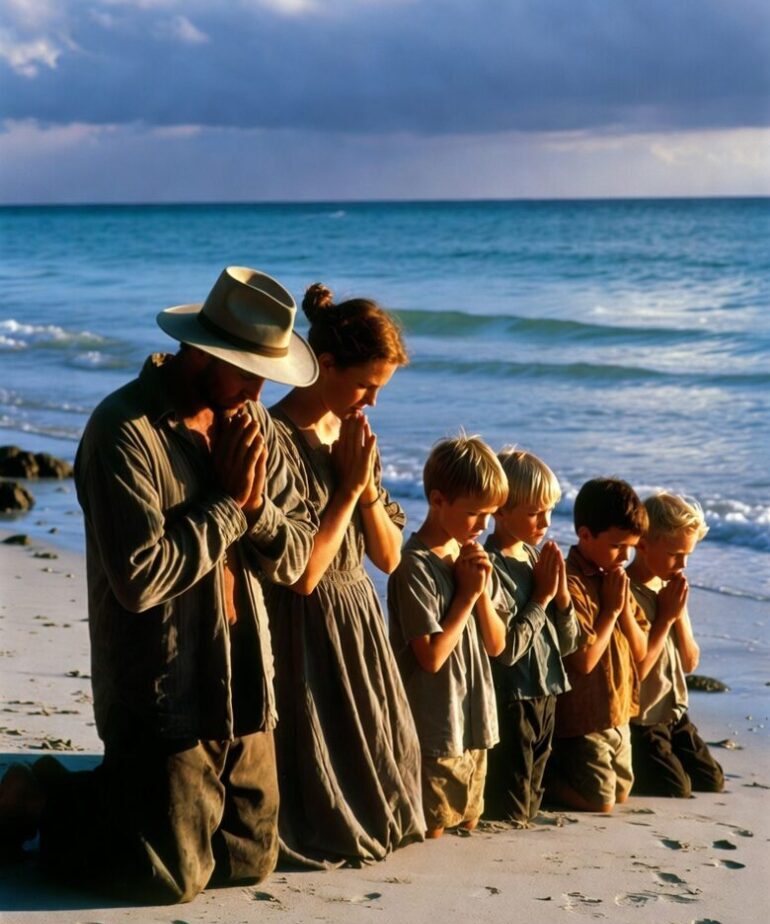
“I’m not dead,” would be my only thought, gasping for breath as I lurched onto the beach. And looking back toward the wreck of the ship, I would surely fall to my knees and offer not a neat recitation from the “Thanksgiving” section of my devotional, but a frantic and garbled prayer of gratitude made more of feeling than of neatly rhymed sentences.
The Robinsons, too, left the structured, well-thumbed missals of their faith and engaged in spontaneous, free-form, intensely personal prayer. In their new world there was no place for the orderly, Protestant math of good deeds plus correct behavior equaling salvation, but instead a raw version of the creator that plunked down what they needed at just the right moment, or provided inspiration that guided the family in solving the most immediate problem. With no realistic confidence that anyone was coming to save them, every fortunate occurrence or happening became an example of benevolent, Divine support.

The core of their belief system abandoned the managerial texts of instructions and rules, and became unfailing faith; and, through that, the bounty of Providence. “Every circumstance has been wonderfully ordered and linked together by Divine Providence,” says Father Robinson, and this unshakeable conviction is their literal salvation, and opportunity for flourishing.
That’s perfect for Robinsonites; harried survivors just holding on, we don’t need lengthy instruction in a fully realized God that we could pick out of a group portrait just from the description we were given. We can believe without specifics, in faith that what sustains us is wholly good, and Providential.
I can work with that, and so present to you:
The Robinsonite Creed
We, the Fellowship of the Church of the Swiss Family Robinson, do solemnly avow and live by this our creed:
In the morning sun and evening stars we see Divine Order,
which generates the benevolent and careful work of Providence.
With diligence, we follow the model of Divine Order
by engaging fully with the world in which we find ourselves,
and fashioning what we need from what is  made available.


We honor hard work and adaptability, knowing these, along with faith,
to be the tools without which we can craft nothing
that will endure the storm-tossed seas of life.


We worry not over Old Switzerland and its trials and tribulations,
about which we can do nothing,
but keep our hearts, minds, and works firmly anchored on the new shore.


We strive to live in harmony with the natural world
and be ever aware that we are part of it,
endeavoring to be conscientious and considerate stewards
of every wilderness we are called to tame,
knowing it all to be Providential.


In all things, we give thanks for the blessings of Providence
and affirm our trust in its constant revelation.
We choose optimism in the fiercest gales as an act of faith,
and greet each day as a fresh start
while also accepting, with grace,
that some things are simply not meant to be.


May we be creative in our work,
consistent in our appreciation,
joyful in our celebrations,
and ever honor the Divine Order that charts the course of the universe.
Ahoy.


2 thoughts on “The Robinsonite’s Creed”